
Dwarka Expressway's Missing Piece: What the September 2026 Service-Road Completion Means for Property Values
Namaskar dosto,
Dwarka Expressway ke baare mein jab bhi baat hoti hai, log sirf ek cheez poochte hain — "kab khulega poora?" Main aapko batata hoon ki yeh sawaal thoda incomplete hai. Expressway toh through-traffic ke liye already chalu ho chuka hai — asli sawaal yeh hai ki local residents ke liye yeh corridor kab poori tarah usable banega. Aur yahi wo cheez hai jo ab September 2026 tak resolve hone wali hai. Chaliye detail mein samajhte hain.
The Update That Actually Matters
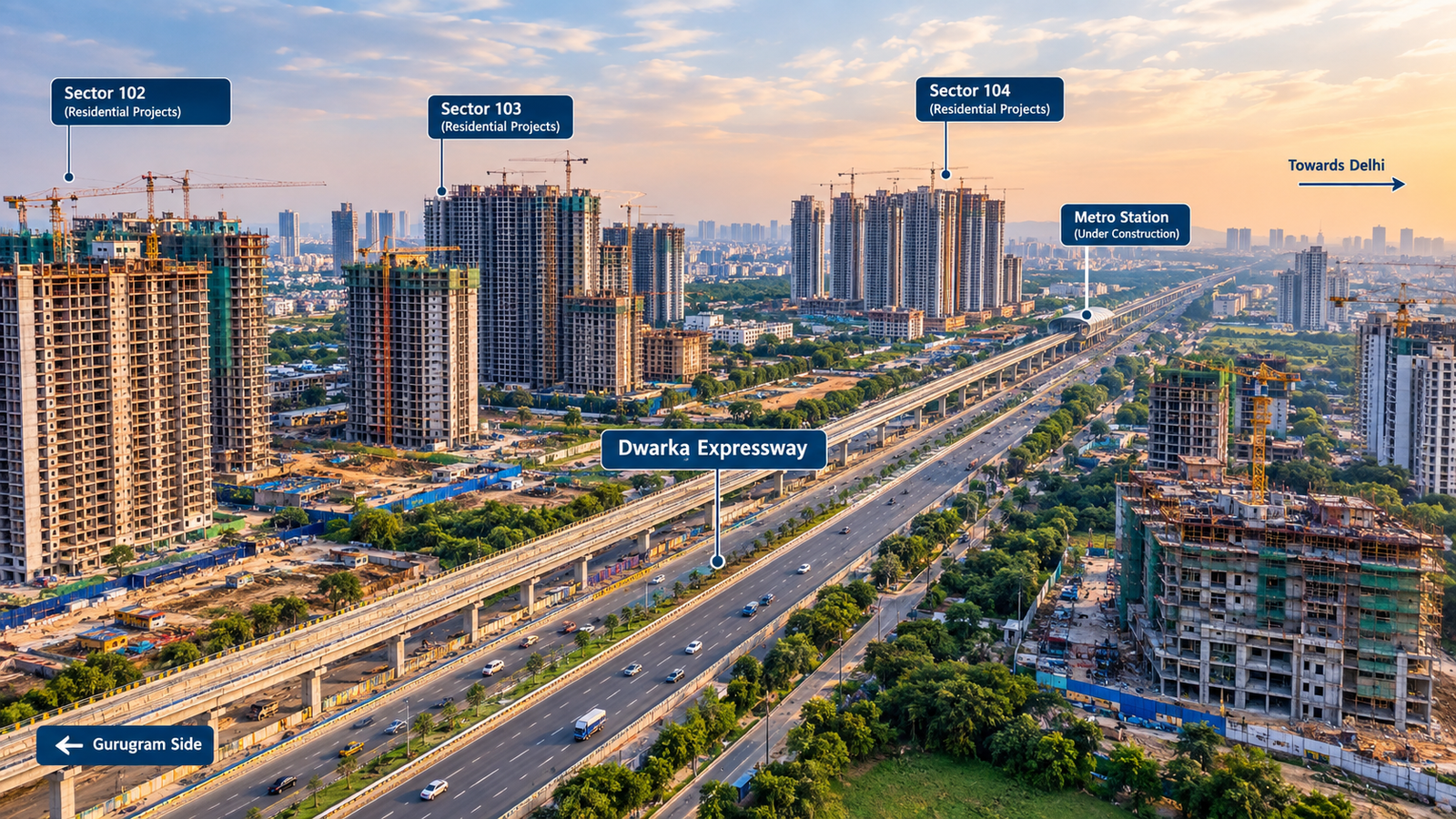
The Dwarka Expressway itself — India's first 8-lane elevated urban highway connecting Delhi's Dwarka sub-city to Gurugram's Kherki Daula toll — has been operational for through-traffic since 2025. But there's been a persistent, practical problem for anyone actually living in the sectors along this corridor: because the expressway is access-controlled, local residents have struggled to get in and out of nearby sectors without navigating long detours.
That's what's being fixed now. The Gurugram Metropolitan Development Authority (GMDA) is constructing approximately 27 kilometers of service roads running along both sides of the expressway. As of the latest updates, this work is roughly 70% complete, with GMDA targeting full completion by September 2026.
This matters more than it might sound. A signal-free elevated highway is a great headline, but for the family that actually lives in Sector 99 or Sector 88A, what changes daily life is whether they can safely and conveniently reach their own sector without a 20-minute detour. That's precisely what these service roads are built to solve — along with dedicated drainage infrastructure designed to handle monsoon waterlogging, which has historically been a real pain point along this stretch.

The Bigger Infrastructure Picture
The service road completion is one piece of a much larger, genuinely funded infrastructure push around this corridor — and I want to walk you through each piece honestly, because not everything in this space is at the same stage of certainty.
Confirmed and under construction:
- The 27 km service road network (GMDA), targeted for September 2026.
In active planning/proposal stage — not yet under construction:
- A Dwarka Expressway extension to Delhi's Mayapuri Ring Road, proposed by Delhi International Airport Limited (DIAL) in a master plan from May 2026. This is aimed at clearing the long-standing bottleneck near Mahipalpur and IGI Airport, where traffic currently crawls inside a three-kilometer tunnel where the expressway merges into NH-48.
- A broader ₹30,000-crore Delhi-NCR road programme, covering six major projects, including an AIIMS–Mahipalpur–Gurugram elevated corridor (construction expected to begin December 2026).
- Metro Phase 4 and a proposed Blue Line spur from Dwarka Sector 21 toward Kherki Daula, targeted for the 2026-27 window, which would give this corridor a direct rail link into Delhi.
- The Global City project — a 1,000+ acre integrated business and residential development along the corridor, with Phase 1 trunk infrastructure (roads, utilities, power) targeted for completion by late 2026.
I'm listing these separately on purpose. It's very common in NCR real estate marketing to blend "under construction" and "proposed" projects into one exciting-sounding narrative. As someone who has watched projects on paper take years — sometimes a decade — longer than initially announced, I'd urge you to treat the service road completion as the near-certain catalyst, and treat the rest as genuine upside that you shouldn't pay a premium for today as if it were already delivered.

What This Has Already Done to Prices
Property rates along the Dwarka Expressway corridor have reportedly stabilized in a broad range of roughly ₹13,000 to ₹24,000 per square foot, according to market data — a wide range that reflects real variation between established sectors closer to Kherki Daula and newer, still-developing pockets further along the corridor. Gurugram-wide circle rates have also risen sharply in sectors along this belt, which I covered in more depth in a separate piece on this site — worth reading if you're seriously considering this corridor, since it directly affects your total acquisition cost.

The Buyer Psychology Shift Worth Noticing
Something genuinely different is happening among buyers on this corridor compared to five years ago. It used to be a purely investment-driven market — buy early, flip later. Increasingly, I'm seeing end-use buyers, professionals working in Gurugram or with frequent Delhi/airport travel needs, treating this corridor as a primary residence choice, not just a speculative bet. The reduced travel time to IGI Airport via the tunnel route — down from 60-90 minutes to a reported 20-30 minutes in signal-free conditions — is a meaningful, tangible lifestyle factor, not just a marketing line.
That shift matters for you as a buyer, because it changes what "good value" looks like. An investment-only buyer cares primarily about resale appreciation. An end-use buyer needs to weigh daily commute reality, social infrastructure (schools, hospitals — still developing in several newer sectors here), and construction quality just as much as the price-per-square-foot number.

Where a Consultant's Judgment Actually Protects You Here
This corridor is a textbook example of where I tell people: don't make this decision off a brochure map and a sales pitch alone. Here's what I actually check before recommending any specific project on this belt:
- Is the specific sector within the 70%-complete service road zone, or in a pocket that's still waiting on connectivity? Not every sector along the 29 km stretch is equally close to completion.
- What is the developer's track record specifically on this corridor, not just their reputation elsewhere — Dwarka Expressway has seen both very strong delivery and some genuinely delayed projects, and brand name alone doesn't tell you which category a specific project falls into.
- Is the project's RERA-registered possession timeline realistic given current construction progress, verified through the RERA portal's quarterly updates — not just the sales brochure's stated date.
- How does the total cost — including the recently revised circle-rate-driven stamp duty — compare across your shortlist? A lower headline price can sometimes hide a similar or higher total acquisition cost once registration charges are factored in.
This is exactly the kind of ground-level verification that a headline like "Dwarka Expressway service roads 70% complete" doesn't give you on its own. The infrastructure story tells you the corridor has momentum. It doesn't tell you whether a specific project, on a specific plot, from a specific developer, is the right decision for your specific budget and timeline.

My Honest Take
The Dwarka Expressway story in 2026 is a genuinely good example of infrastructure-led real estate growth rather than pure speculation — the service roads are real, under construction, and close to completion; the metro and extension plans, while not yet built, are backed by serious government planning momentum; and end-use demand is visibly strengthening alongside investor interest.
That said, "the corridor is strong" doesn't mean "every project on it is a good buy at today's price." Match your specific sector choice to the actual infrastructure completion stage, verify the developer's delivery record on this exact corridor, and don't let the excitement of a near-term deadline (September 2026) push you into skipping your document-level checks.
A Note from Zameendaar Sahab: With 35 years in Delhi NCR real estate, I've seen enough infrastructure promises to know the difference between "under construction" and "under discussion" — and I try to be equally clear with you about both. This article is for general informational purposes and isn't financial or legal advice. Please independently verify RERA status, construction progress, and total acquisition costs before committing, and reach out directly if you'd like a personalized view for your specific shortlist.