
Namaskar dosto,
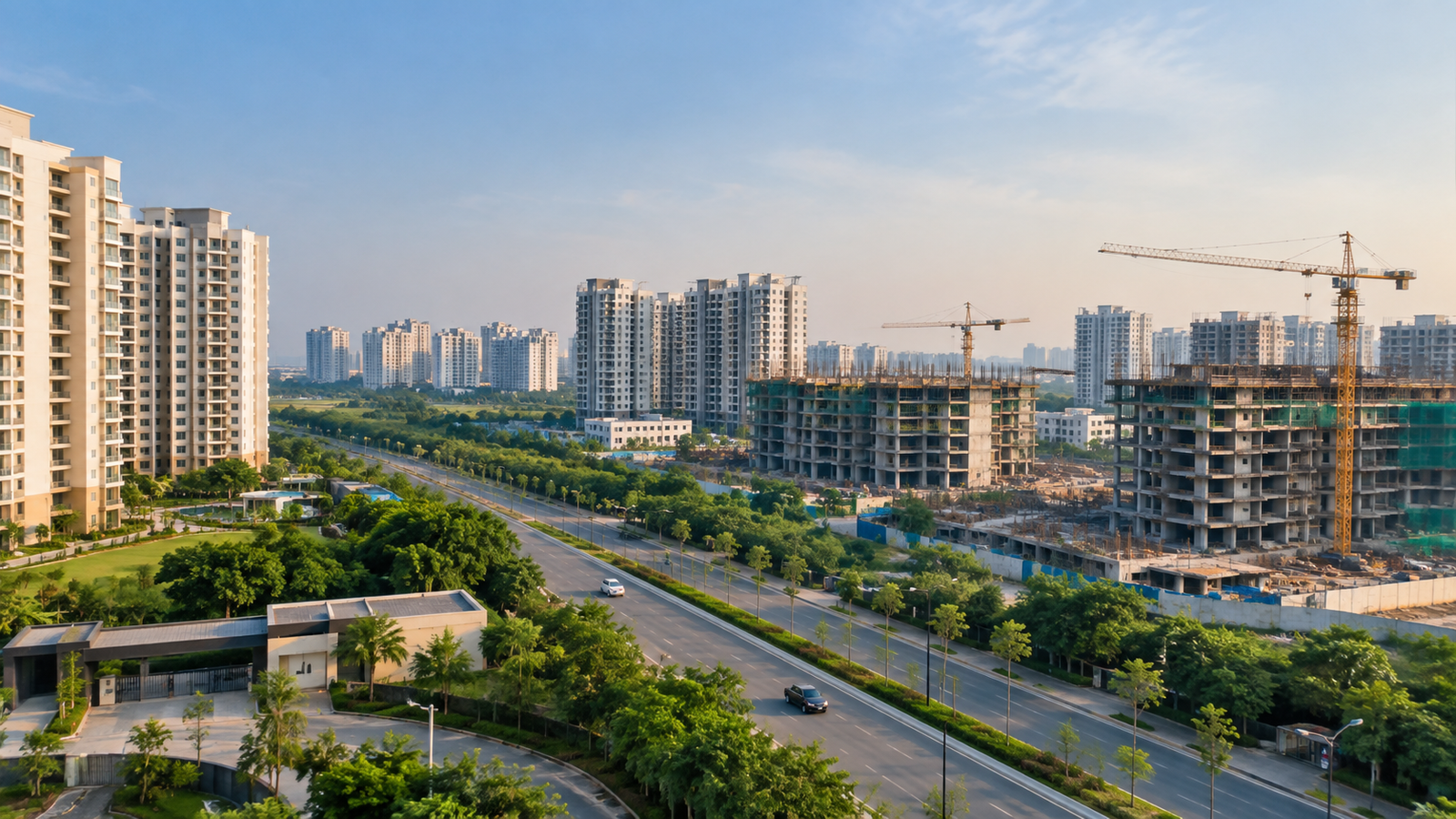
Greater Noida ke baare mein log aksar do extreme baatein karte hain — ya toh "yeh next big boom hai," ya "yahan toh sirf construction hi construction hai, kuch delivered nahi hota." Sach, hamesha ki tarah, in dono ke beech mein hai. Aaj main aapko actual numbers dikhata hoon — 25% sales growth, ek naya railway overbridge, aur GNIDA ka commercial land plan — aur phir hum ईमानदारी se decide karenge ki iska matlab kya hai.
The Numbers on the Table
Greater Noida recorded a 25% growth in residential sales during Q1 2026 — the highest quarter-on-quarter increase across the entire NCR for that period. That's a meaningful, specific figure, not a vague "market is doing well" claim.
Separately, GNIDA (Greater Noida Industrial Development Authority) has earmarked 153.63 hectares of land for commercial development, signaling the authority's own intent to build Greater Noida into more than just a residential dormitory city for Delhi and Noida — it's actively planning for jobs and commerce to be generated locally.
And on the connectivity front, a new DFCCIL railway overbridge on the 130-meter road has opened, improving the connection between Greater Noida and Greater Noida West. If you've ever tried to move between these two zones during peak hours, you'll know exactly why this matters — it directly targets a long-standing congestion bottleneck between the two belts.

Why This Quarter's Sales Growth Is Different From Just "Hype"
I want to be careful here, because I've seen quarters of strong sales that were driven almost entirely by one or two large launches, not genuine broad-based demand. So before I tell you this is a meaningful trend, let me show you why I think it is:
1. It's backed by registration data, not just developer press releases. Separately reported Inspector General of Registration data has shown property registrations across Noida and Greater Noida rising, with Greater Noida accounting for a majority share (around 62%) of that transaction volume in a recent quarter — meaning actual registered sales, not just booking announcements, back up the sales-growth narrative.
2. It's happening alongside genuine infrastructure delivery, not just promises. The DFCCIL overbridge is complete and operational — not a proposal. That's a meaningful distinction from markets where "infrastructure-led growth" is really just a pitch built around a project that's still years from breaking ground.
3. The Jewar Airport effect is real, but Greater Noida's story isn't only about the airport. Unlike the Yamuna Expressway belt, where the entire investment thesis is essentially "proximity to Jewar Airport," Greater Noida's growth case rests on multiple legs — established residential demand, GNIDA's own commercial land planning, connectivity improvements between its own sub-zones, and yes, some spillover benefit from the airport corridor as well.

What GNIDA's Commercial Land Plan Actually Signals
I want to spend a moment on the 153.63-hectare commercial land allocation, because I think it's under-discussed compared to flashier residential news, and it's actually one of the more important long-term signals in this market.
A city that's purely residential — where everyone commutes elsewhere for work — has a structurally different demand profile than a city building its own commercial and employment base. If GNIDA follows through on developing this land into genuine office space, retail, and commercial activity (and follow-through is the key word — I'll come back to that), it changes Greater Noida from a "sleep here, work in Noida/Delhi" market into a market with its own gravity. That typically supports more durable, less commute-dependent property demand over the long run.
The caveat: land allocation is a plan, not a delivered outcome. I've watched authority land-use plans in NCR take anywhere from 3 to 10+ years to materialize into actual occupied commercial space. Treat this as a genuine positive signal about the region's direction, not as something that changes your investment math today.

Greater Noida vs. Its Neighbors — An Honest Comparison
One thing I always tell people considering Greater Noida: understand what you're actually comparing it to.
- Versus Noida: Greater Noida generally offers a more affordable entry price for comparable configurations, but with less mature social infrastructure in several sectors and typically longer commute times to established Delhi/Noida employment hubs.
- Versus Greater Noida West (Noida Extension): These are often lumped together in casual conversation, but they have different histories — Greater Noida West went through a well-documented "lost decade" of stalled projects and litigation roughly between 2013-2018, and is still in a recovery phase in terms of buyer trust, even though it's now growing again. Greater Noida proper (the older Alpha/Beta/Gamma/Chi/Zeta sector belt) has a longer, generally steadier delivery track record.
- Versus the Yamuna Expressway: Greater Noida offers more immediate livability — existing schools, hospitals, and retail — versus the Yamuna Expressway's higher-risk, higher-potential-reward profile centered almost entirely on the airport catalyst.

Where a Consultant's Ground-Level Knowledge Changes the Outcome
Greater Noida is a market where developer track record matters more than almost anywhere else in NCR, precisely because of that stalled-project history in the wider region. Here's what I actually do differently when someone's evaluating a Greater Noida purchase:
- I check whether the specific developer delivered on time in Greater Noida specifically — not just their reputation in Noida or Gurugram, since execution capability and local authority relationships genuinely vary by micro-market.
- I verify whether the project sits in an established sector (Alpha, Beta, Gamma, Delta, Chi, Zeta) or a newer, less-tested one (Omicron, Pi, Sigma, Tau, Mu, Nu, Xu, Eta, Omega) — the newer Greek-letter sectors carry meaningfully different risk profiles even within Greater Noida itself.
- I ask direct questions about the DFCCIL overbridge and other connectivity claims — is the project's marketed "close to new overbridge" claim measured by actual drive time, or straight-line distance on a map?
- I look at whether GNIDA's commercial land plans are anywhere near the specific project, since proximity to genuine future commercial development can meaningfully affect long-term rental and resale demand — but only if it's real, funded land use, not a marked zone on a master plan that hasn't moved in years.
This is exactly the layer of verification that a "25% sales growth" headline can't give you. It tells you the market has momentum. It doesn't tell you whether the specific project in front of you is standing on solid ground — literally and figuratively.

My Bottom Line
Greater Noida's Q1 2026 numbers — 25% sales growth, a completed overbridge, and a genuine commercial land plan from GNIDA — paint a picture of a market with real, multi-legged momentum, not a single-catalyst story. That makes it, in my honest view, one of the more balanced propositions in NCR right now: more affordable than Noida or Gurugram, with less single-point risk than the Yamuna Expressway's airport-dependent thesis.
But "balanced market" still requires sector-specific and developer-specific diligence. Don't buy the region — buy the specific project, on the specific sector, from the specific developer, after you've verified all three independently.
A Note from Zameendaar Sahab: Over 35 years of watching Delhi NCR grow sector by sector, I've learned that a region's average numbers rarely tell the whole story of any one project. This article is for general informational purposes and isn't financial or legal advice. Please verify GNIDA approvals, RERA registration, and developer track record independently before investing, and feel free to reach out directly for a personalized view.