
Ask ten property agents in Noida where to buy and you'll hear ten answers, each one pointing, conveniently, at whatever they happen to be selling that month. Buyers rarely lack options. What they lack is a filter.
One filter beats most others. Watch where government bodies and big manufacturers are pouring money into concrete: expressways, rail lines, an airport, factory floors. Jobs land where that money lands, and rent tends to follow the jobs a few years later.
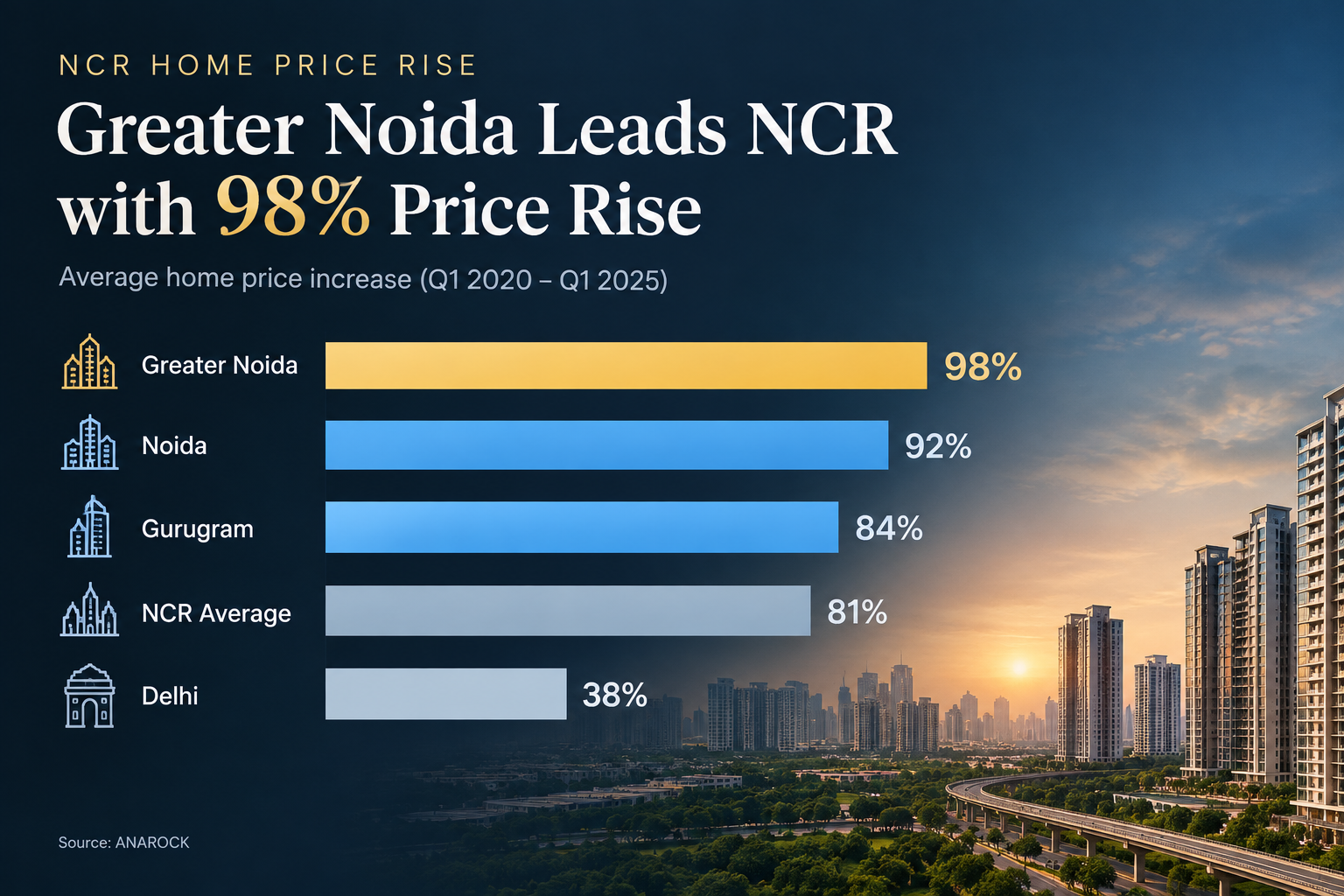
By that measure, Noida and Greater Noida are hard to ignore. ANAROCK figures show average home prices rose 98% in Greater Noida and 92% in Noida between Q1 2020 and Q1 2025, the two sharpest rises anywhere in the NCR (source). That is history, mind you, not a forecast.
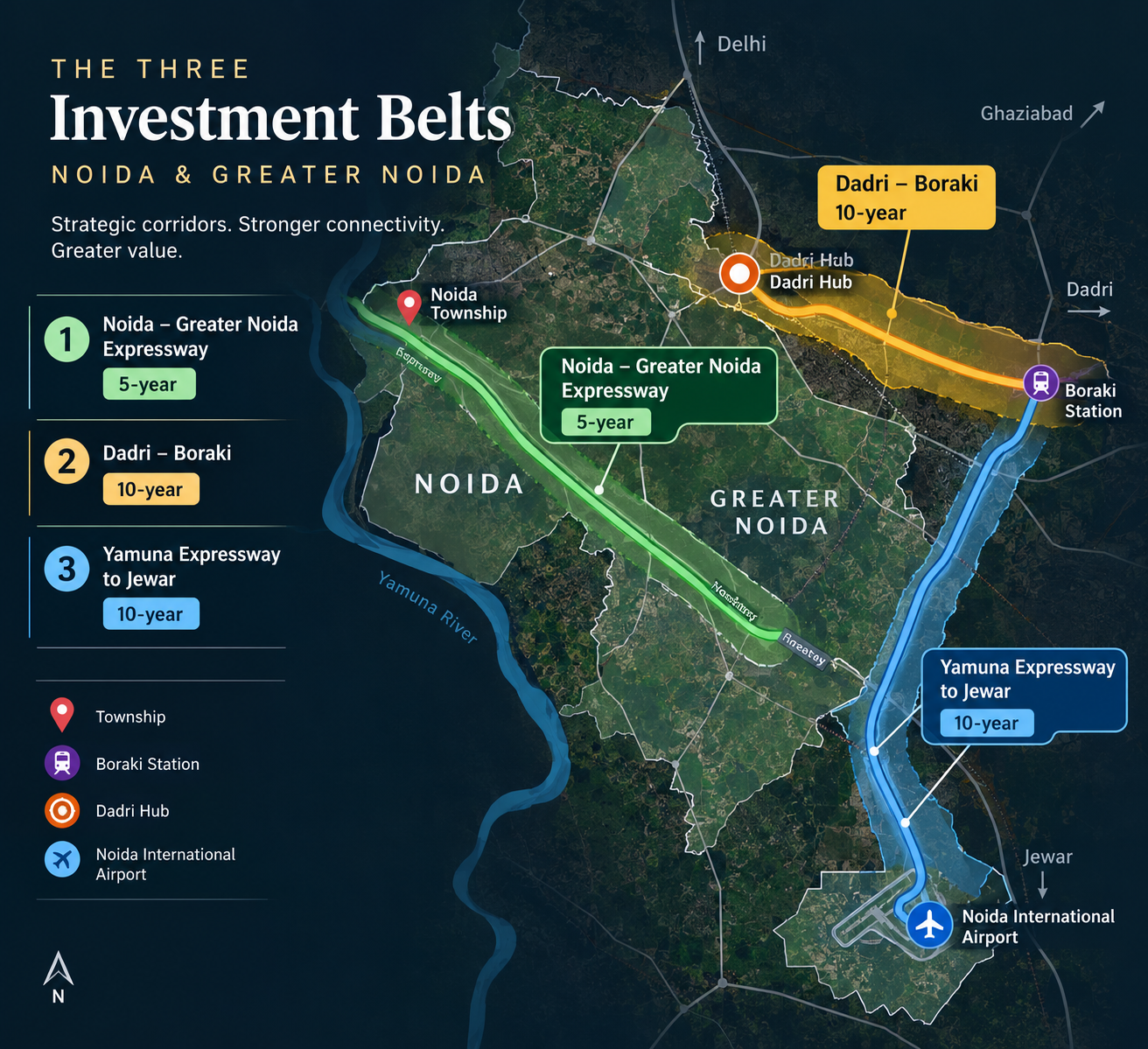
Below you'll find the three belts drawing this spending, the 747.5-acre township at the centre of it, and a frank split between five-year and ten-year plans. Two business owners' stories show how it works on the ground.
Three belts, three different clocks
Most new money is landing in three places. The Noida–Greater Noida Expressway, already lined with offices, metro stations and occupied towers. The Dadri–Boraki stretch of Greater Noida, where a government industrial township sits beside two planned transport hubs. And the Yamuna Expressway towards Jewar, where Noida International Airport began commercial flights in June 2026.
Each one runs on its own clock. On the Expressway you pay for demand that already exists — tenants are there today, and so are resale buyers — which is why it usually suits people thinking about five years. Dadri, Boraki and the land around Jewar sit earlier in the cycle, with approvals granted and some construction under way. Any payoff there needs something closer to ten years of patience.
The township is the part most buyers have never looked at closely. So start there.
Global Business City: the 747.5-acre township behind the name
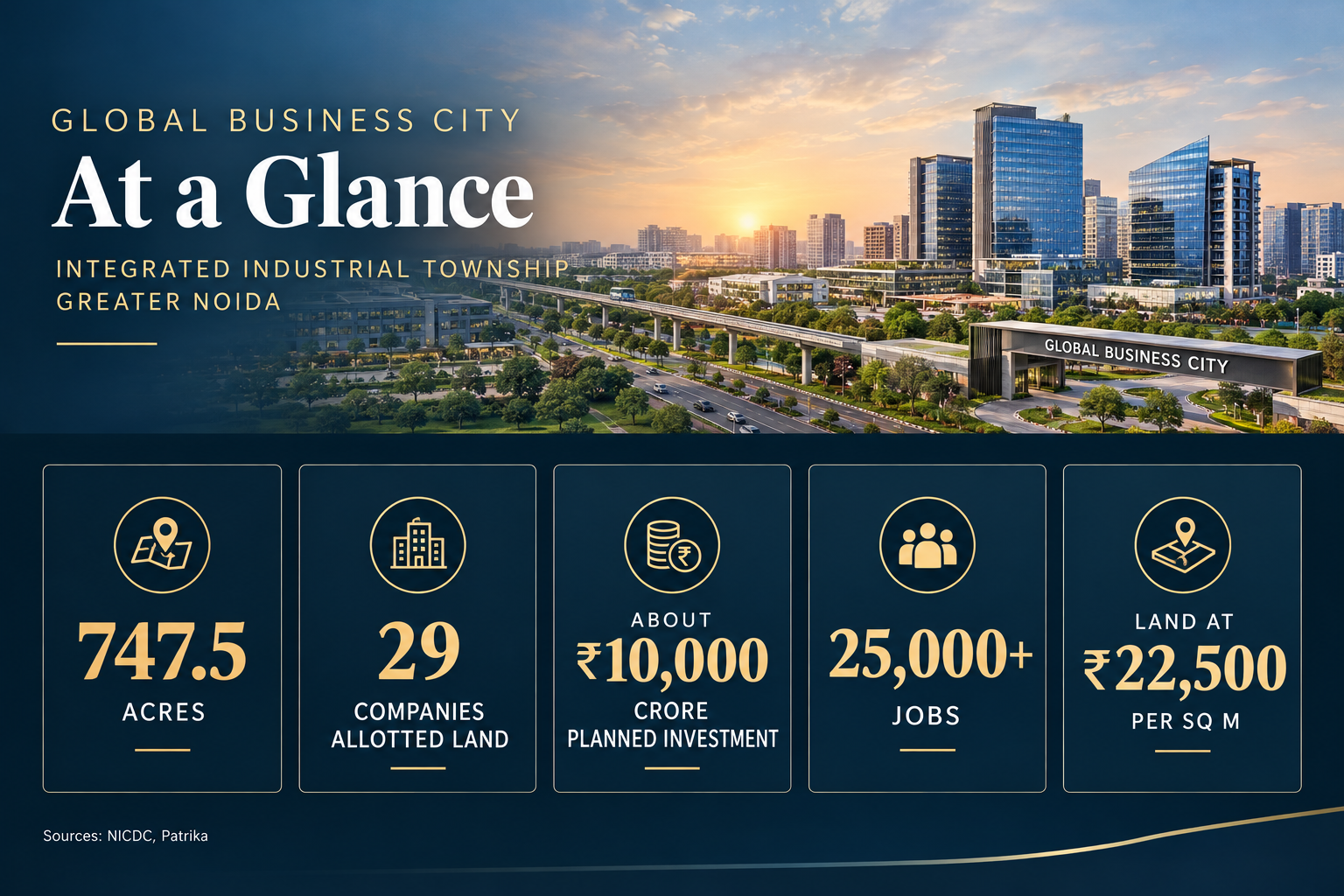
"Global Business City" is the marketing name. On paper it is the Integrated Industrial Township Greater Noida (IITGN), 747.5 acres in the south-east of the city, though nearly everyone rounds it to 750.
No private builder owns it. DMIC Integrated Industrial Township Greater Noida Limited (IITGNL) runs the show, and that company is split 50:50 between the Greater Noida Industrial Development Authority (GNIDA) and a central government trust (NICDC). That matters more than it sounds. Roads, power and water here don't hinge on one developer's cash flow.
Part of the Delhi–Mumbai Industrial Corridor
The township was one of the first projects under the Delhi–Mumbai Industrial Corridor (DMIC), a national plan to seed manufacturing cities along the goods-only railway linking the two cities. It falls inside the Dadri–Noida–Ghaziabad Investment Region, one of eight zones picked for phase one. Goods made here can reach west-coast ports and eastern markets by dedicated freight rail.
Between the expressway and the main line
The site touches the Eastern Peripheral Expressway on one side and the Delhi–Howrah railway line on the other, about 11 km from Pari Chowk (NICDC project page). Boraki's planned transport hub is roughly 4 km away. The Dadri logistics hub, about 6 km (GNIDA scheme notice).
29 companies already hold land
This is not empty land waiting for tenants. By May 2025, 29 companies had been allotted plots, carrying roughly ₹10,000 crore of planned investment and more than 25,000 direct and indirect jobs (Patrika). Four foreign firms were already producing.
|
|
|
|
|
|
|
|
|
|
|
|
|
|
|
|
|
|
|
|
Satkriti Infotainment, Chenfeng and Korea's GKS Digital are among the other names.
Factories first, homes after
A plant like Haier's needs far more than line workers. Engineers, quality managers, supplier staff, drivers — and every one of them wants a flat, a school and a pharmacy within reasonable reach. IITGNL has now begun auctioning group housing plots, with an e-auction expected to raise over ₹1,100 crore (The Realty Today). Here, the homes are following the jobs rather than running ahead of them.
Boraki Multi Modal Transport Hub (MMTH)
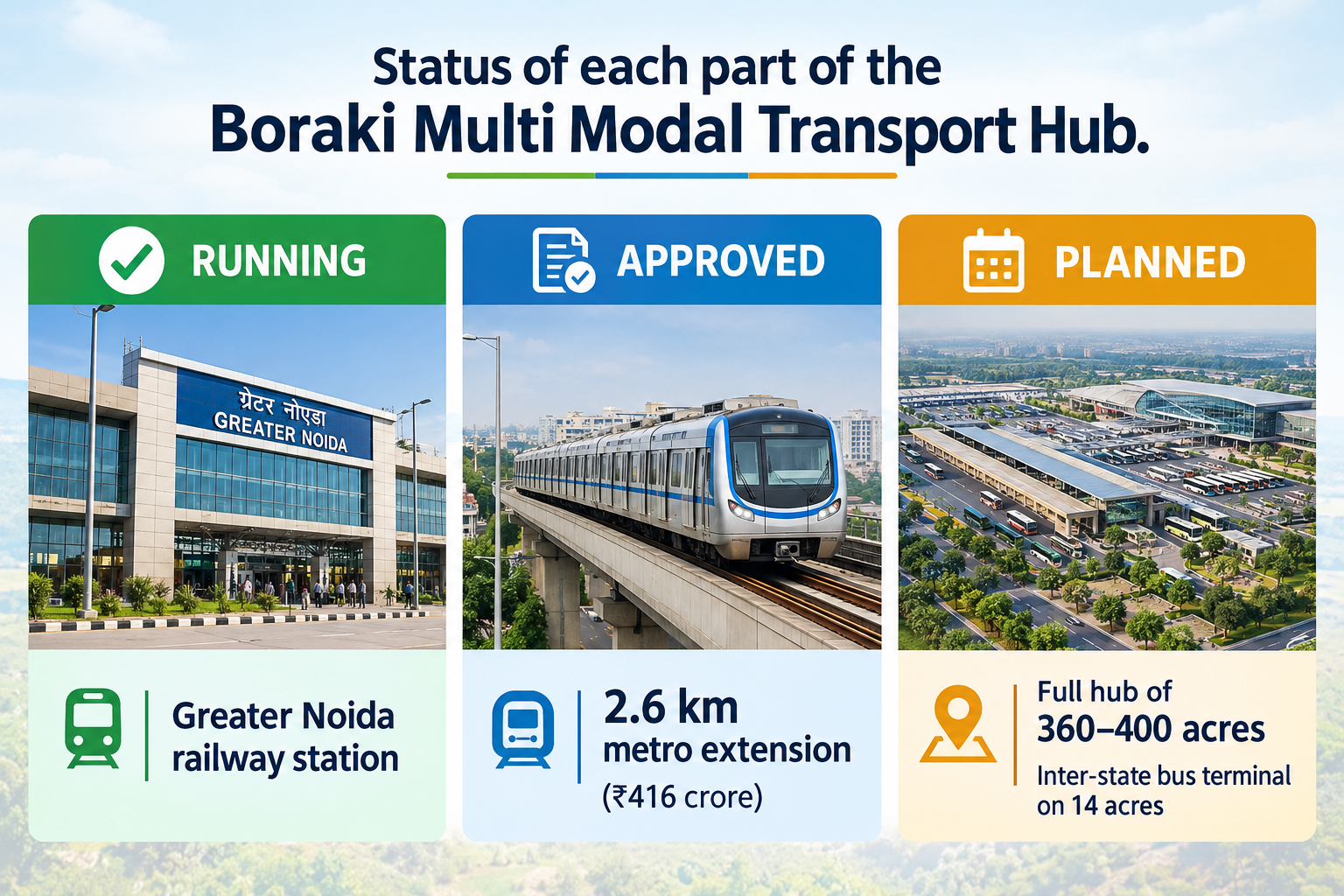
Trains, inter-state buses and the Noida Metro, all meeting at a single point in Greater Noida. That's the whole idea of the Multi Modal Transport Hub, or MMTH, at Boraki.
It is being built around the old Boraki station, since renamed Greater Noida railway station. You will see 400 acres quoted for the hub in older plans; NICDC's current project page lists 360.
Taking pressure off Delhi's stations
Anyone in Greater Noida who has battled traffic to New Delhi station for a train to Patna will see the point straight away. Boraki sits on the Delhi–Howrah main line, and many eastbound services to eastern Uttar Pradesh, Bihar and West Bengal are expected to start here instead (Maritime Gateway). Two hours to the station could shrink to fifteen minutes.
Metro and buses
In March 2024 the Uttar Pradesh cabinet cleared a 2.6 km Aqua Line extension from Depot station to Boraki: two new stations, about ₹416 crore (Housing.com). It then went to the Centre for approval. Separately, 14 acres near Boraki are earmarked for an inter-state bus terminal, a workshop and a CNG station.
Built versus planned
The station works; trains stop there every day. Everything else — the full hub, the metro link, the bus terminal — is still moving through approvals and planning, backed by a Memorandum of Understanding (MoU) with the Ministry of Railways (NICDC). Price a home near Boraki on what runs today, and treat the rest as upside.
Route: Depot Metro Station to Boraki Multi-Modal Transport Hub (MMTH).
Length: 2.6 km, with 2 elevated stations.
State Government Approval: Uttar Pradesh government approved the Detailed Project Report (DPR) on 6 March 2024.
Central Government Approval: The DPR was forwarded to the Union Ministry of Housing and Urban Affairs on 14 March 2024. Final central approval status requires confirmation.
Construction Tender: Tendering for the elevated viaduct and stations was reported in May 2026.
.
Dadri Multi Modal Logistics Hub (MMLH)
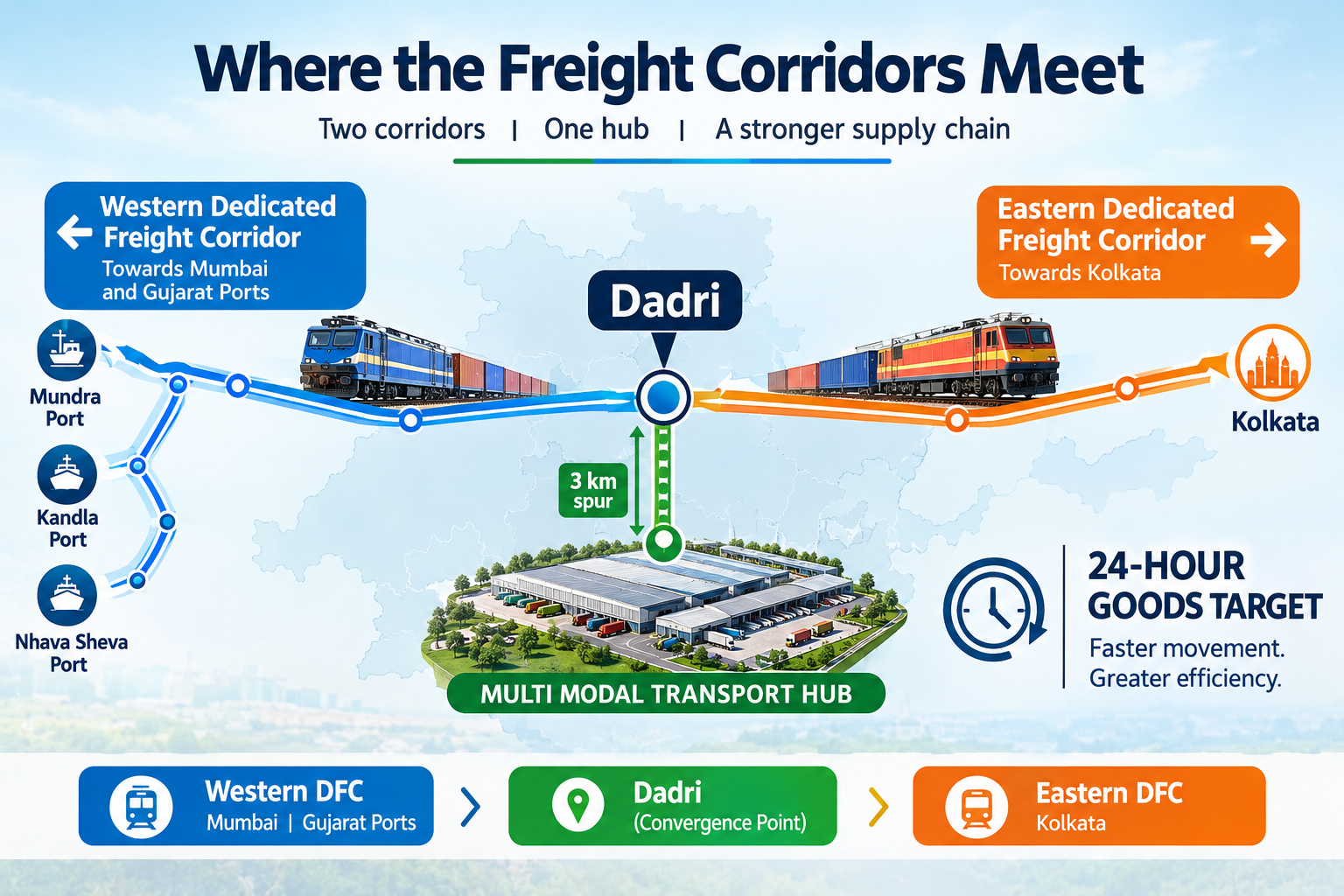
Where Boraki moves people, Dadri will move goods. The Multi Modal Logistics Hub is planned as a dry port — an inland container depot where cargo is stored, cleared by customs and put on trains, hundreds of kilometres from the sea.
Adverts often call it a 400-acre project. It is closer to double that. The latest tender describes 311 hectares, roughly 770 acres, at an estimated ₹5,881 crore (India Seatrade News), and earlier plans went as high as 823.
Where two freight corridors meet
India has built two Dedicated Freight Corridors (DFCs), railway lines reserved for goods trains: the Eastern towards Kolkata and the Western towards the ports near Mumbai. They meet at Dadri. A 3 km spur costing about ₹858 crore will tie the hub to New Dadri DFC station, with the target of moving cargo from Greater Noida to Gujarat, Kolkata or Mumbai inside 24 hours (Maritime Gateway).
Status in October 2026
The first tender drew too few bidders. Fresh bids went out in mid-2026, a private operator will build and run the hub, and construction is split into three phases. Over 90% of the land was in hand by May 2026 (India Seatrade News). A ten-year story, then.
Dadri Multi Modal Logistics Hub (MMLH) — Status as of October 2026
- Project cost: ₹5,881 crore.
- Planned area: 311 hectares (approximately 770 acres).
- Tender status: Three bidders were listed following technical evaluation on 31 August 2026: Adani Ports and Special Economic Zone Limited, Essar Ports Limited, and JSW Infrastructure.
When it does open, warehouses will need drivers, forklift operators, supervisors and customs clerks by the hundred. Most will rent, and most will want an affordable flat a short ride away — which is exactly the kind of demand that keeps mid-priced homes occupied.
The case for Greater Noida as NCR's next business centre
Plenty of towns can point to one big project. Very few can fit a factory township, a passenger rail hub, a freight dry port, three expressways and an international airport inside a 40 km circle. Around Dadri and Boraki, that is the map.
Expressways in three directions
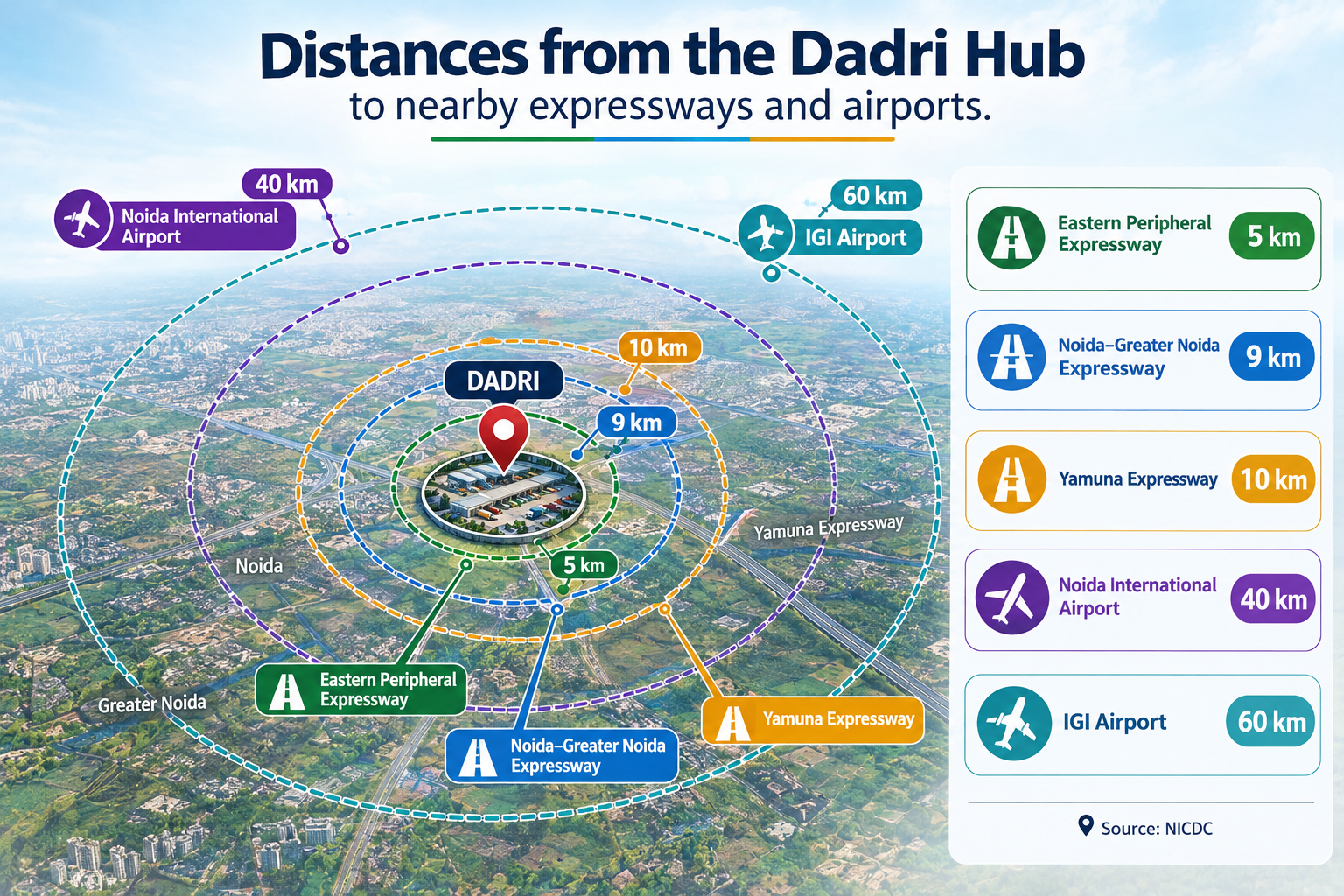
From the Dadri hub it is about 5 km to the Eastern Peripheral Expressway, 9 km to the Noida–Greater Noida Expressway and 10 km to the Yamuna Expressway, by NICDC's count. The first rings Delhi and joins highways running north and west. The second carries the morning office crowd into Noida. The third heads 165 km south to Agra, passing the new airport on the way.
A fourth road is being built: 31.4 km from Ballabhgarh in Faridabad to Jewar, joining the Delhi–Mumbai Expressway. The Union Cabinet signed off a revised ₹3,630.77 crore in March 2026 (NBM&CW). April 2027 is the reported target. Targets slip.
Faridabad–Jewar link road — latest status
- Length: 31.4 km
- Approved cost: ₹3,630.77 crore
- Reported completion target: April 2027
- Latest confirmed completion date from NHAI: No revised date verified. Retain April 2027 as the reported target until NHAI announces an update.
Jewar airport is flying
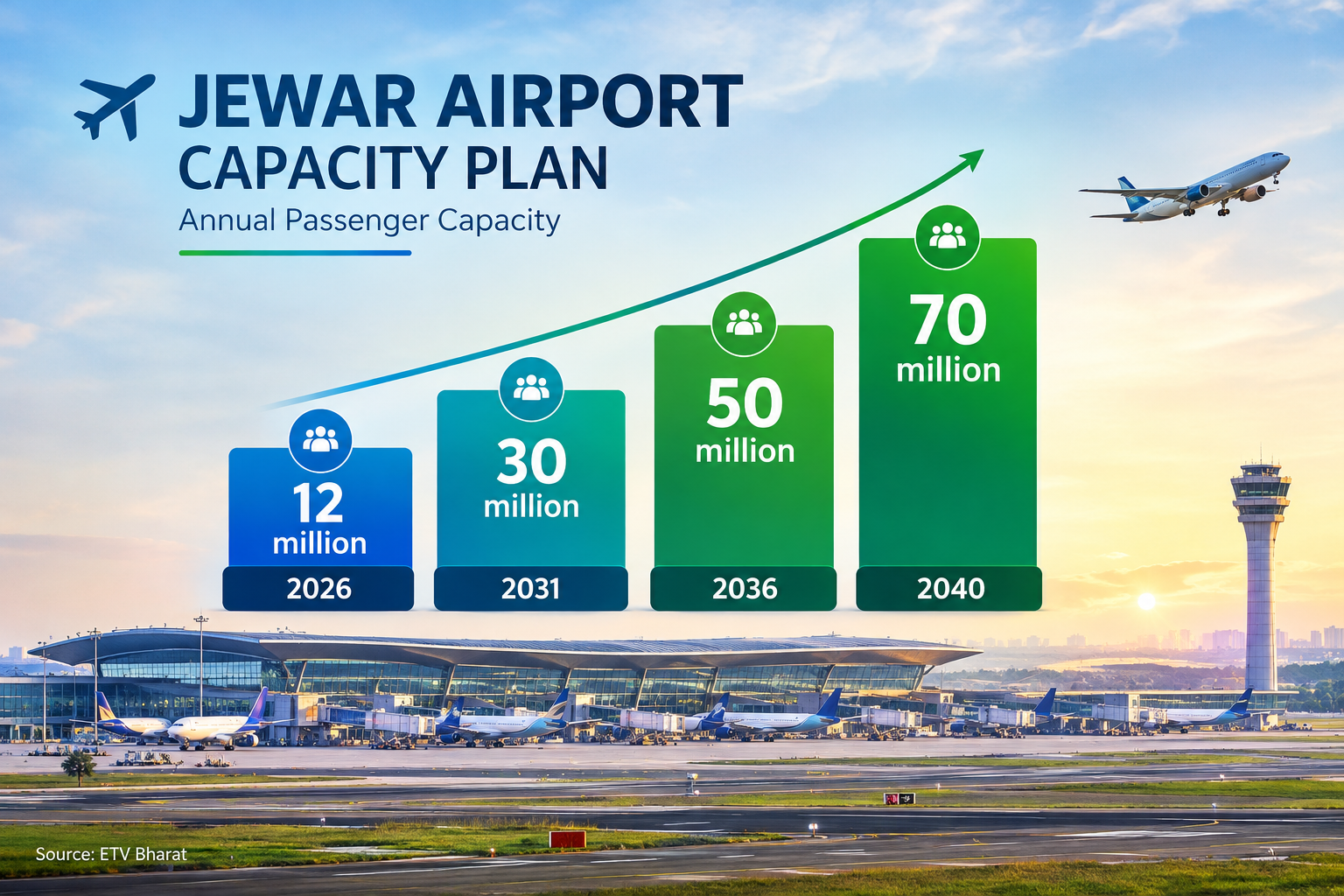
Noida International Airport opened to commercial flights on 15 June 2026, IndiGo first off the blocks. Phase one handles 12 million passengers a year, with 30 million planned by 2031 and 70 million by 2040 (ETV Bharat). Dadri is roughly 40 km away. When a manufacturer weighs Greater Noida against Gurugram, a second international airport down the road can tip the decision.
Rail for passengers and for freight
The Delhi–Howrah main line runs through Boraki. Both freight corridors meet at Dadri. Few places in north India have both within a few kilometres of each other, and for a company shipping fridges to Kolkata and components from Mundra, that pairing cuts real money from the logistics bill.
Global manufacturers are already here
Haier is the obvious example: a working plant, an expansion under way, and over ₹1,000 crore more announced for 2024–2028 (Haier India). Korean, Chinese and Indian firms hold plots, and interest from Japan and Singapore has been reported. A short drive down the Yamuna Expressway, the Yamuna Expressway Industrial Development Authority (YEIDA) has approved an HCL–Foxconn chip assembly unit worth about ₹3,706 crore, alongside a 1,000-acre film city (Realty n More).
The job numbers that can be verified
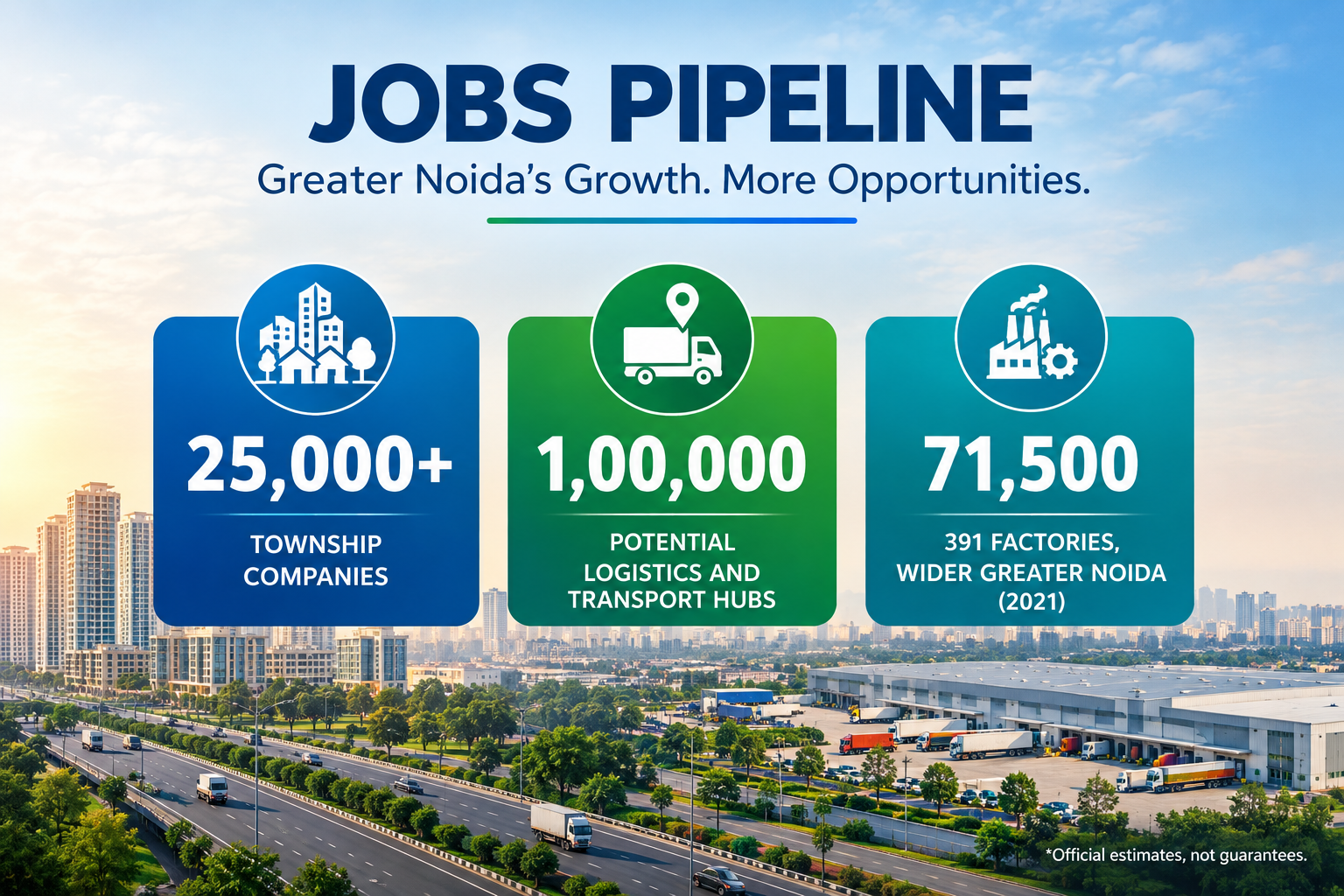
- 25,000+ direct and indirect jobs linked to the township's 29 allotted companies.
- 1,00,000 jobs listed as the employment potential of the logistics and transport hubs on NICDC's page.
- 71,500 people, the Uttar Pradesh government said in 2021, would work in 391 factories across the wider Greater Noida area.
Numbers you will hear, and what they really cover
You may hear that "₹26,000 crore has been invested in the township". The official figure we found is ₹26,530 crore, but it covers the whole Greater Noida authority area over four and a half years to 2021, not the township alone, as per the UP government. The township itself has about ₹10,000 crore committed.
You may also hear claims like "90% of investment is foreign". We could not find an official source for that. Good advisors will show you the document behind every number.
How business owners can use this growth
Investors are only part of the picture. Some of the people best placed to gain from this belt already make things here, or nearby. Two composite examples — the names are invented, the situations are common.
Rajat Malhotra: factory in the region, home an hour away
Rajat runs a sheet-metal and plastic-moulding unit that supplies parts to appliance makers in and around the township. His plant is in Greater Noida. His family lives in South Delhi, so most days begin and end in traffic, and a call about a breakdown on the night shift means another long drive back.
Moving closer changes more than his commute. A home along the Noida–Greater Noida Expressway, or in the planned group housing inside the township, puts him minutes from the shop floor rather than an hour or more. He keeps the Eastern Peripheral and Yamuna Expressways within easy reach for supplier visits. When a buyer from Seoul or Shenzhen flies in, Jewar is about 40 km from Dadri instead of a crawl across Delhi to IGI.
The gains are practical ones:
- Hours back every week, and the ability to be on site quickly when something goes wrong.
- Schools and daily needs improving around him as more of his own industry moves in.
- The option to rent out the Delhi flat, or hold it, rather than selling under pressure.
- A home bought where he already has a reason to be, not on a hunch about the next hotspot.
If Rajat buys, it should be because the location works for his life and business today. Any rise in value is a bonus he can't count on.
Sunil Yadav: running a unit from an unregularised area
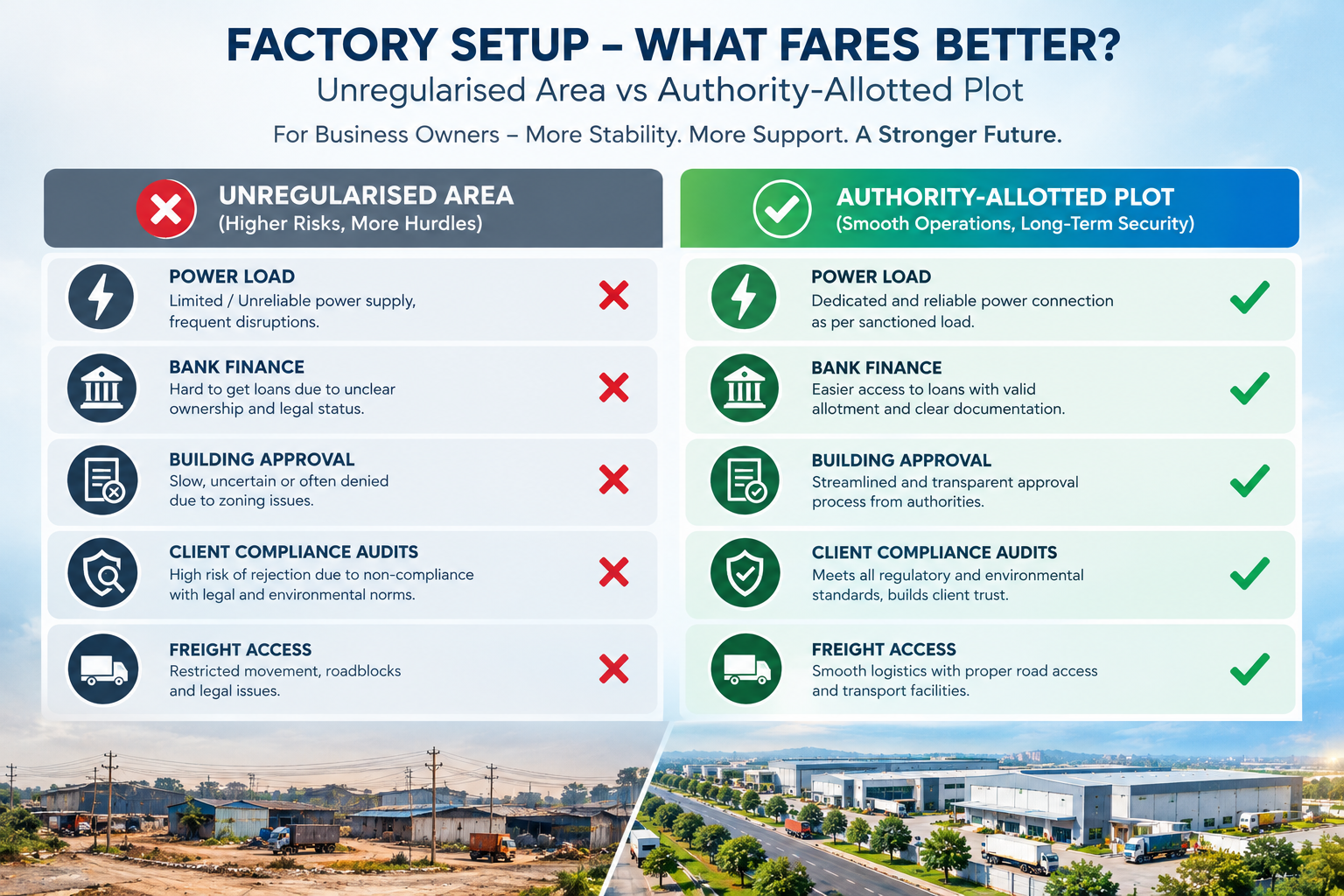
Sunil makes corrugated boxes for FMCG and appliance companies. His unit sits in an unregularised industrial pocket — land where factories grew up without an approved industrial layout. The work is steady. The paperwork isn't.
That status costs him in quiet ways. Getting a higher power load sanctioned is a struggle, and banks hesitate to lend against a building with no approved map. Large clients increasingly ask for compliance audits that he can't pass, and there is always a worry about a sealing drive.
An allotted plot from an industrial authority solves most of this at once: clear lease terms, an approved layout, and utilities built for industry. Inside the IITGN township, NICDC lists land at ₹22,500 per square metre (about ₹9.67 crore an acre), power at ₹6.80 a unit and treated water at ₹3 per kilolitre (NICDC). His biggest customers would also be next door, and the Dadri freight hub would sit about 6 km away once it opens.
Timing matters for a reason that has nothing to do with speculation. Authority rates get revised; YEIDA, for example, raised land costs in its area by 5.41% in a single budget year (India Seatrade News). Securing a plot at today's rate, while prime parcels near the freight corridor are still available, locks in his cost before the belt fills up.
There are catches. IITGN plots run from 2 to 15 acres, which is large for a box maker, so a unit Sunil's size may fit better in the Greater Noida authority's or YEIDA's own industrial plot schemes, which open from time to time. Allotments usually come with a deadline to build and start production, and idle plots can be cancelled. He should line up a project report and finance before he applies, not after.
YEIDA industrial plots: The latest general industrial plot scheme (YEA/IND8000(2025-26)-14) closed on 19 February 2026. Plot sizes ranged from 300 sq m to approximately 7,051 sq m, with published rates starting at ₹15,670 per sq m for plots up to 4,000 sq m. Applications are closed.
Matching areas to a 5-year or 10-year plan
If you need the money back in roughly five years, buy where things already work. If you can leave it for ten, you can afford to buy where things are still being built.
|
|
|
|
|
|
|
|
|
|
|
|
|
|
|
|
|
|
|
|
|
|
|
|
|
|
|
|
|
|
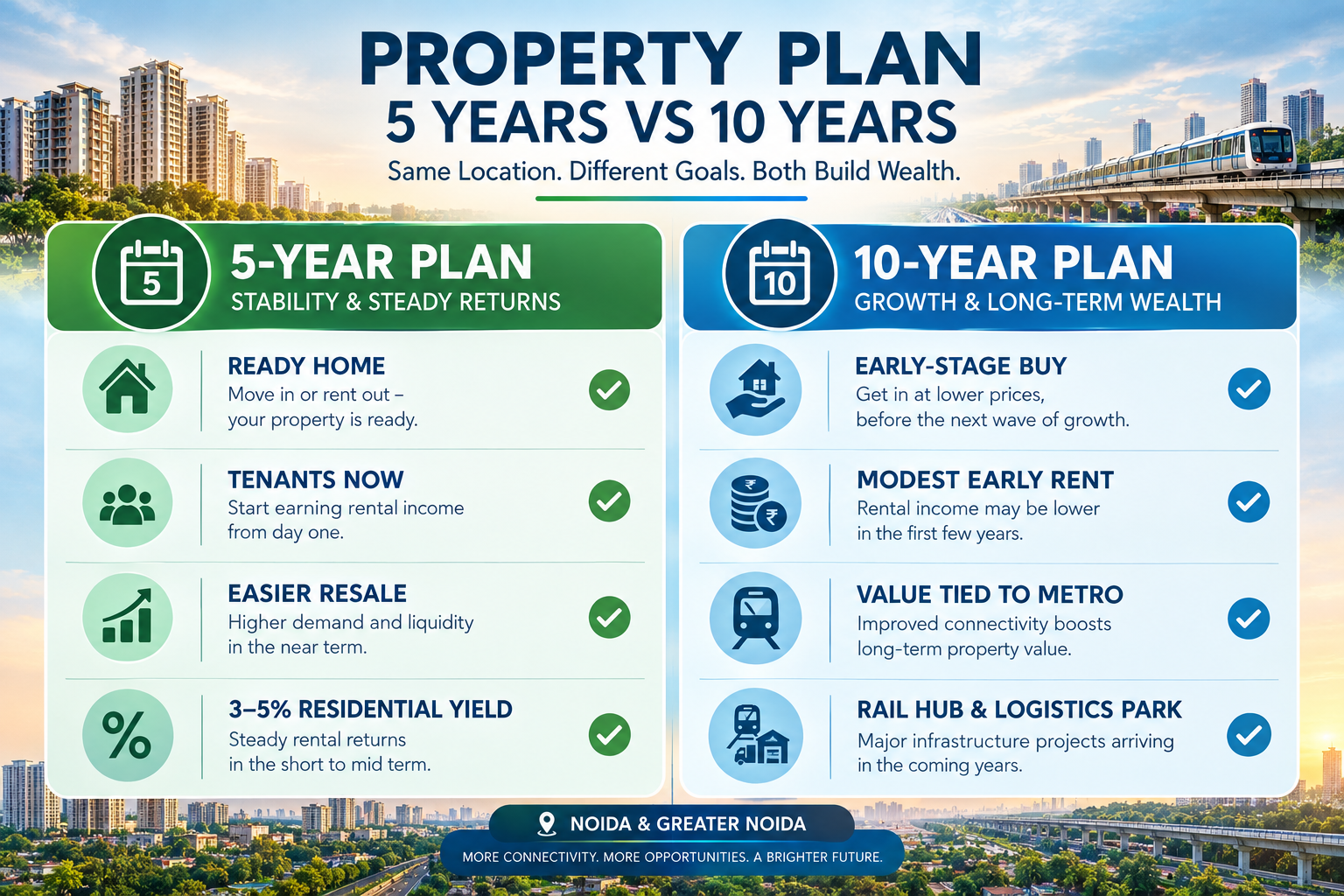
The five-year buyer pays for certainty: a ready or nearly ready home, tenants already in the neighbourhood, and resale buyers who don't need persuading. Less room for a big jump, in exchange. Residential rents in Greater Noida tend to return 3–5% of value a year, some commercial units 6–7%, according to a Sobha market guide — a developer's rough range, not a promise.
The ten-year buyer gets in before an area fills up, and accepts thin rent early on. Picture a flat near Boraki today, then picture the same street once the metro, the rail hub and the logistics park are running. That's the bet. It only works if you can absorb a delay, and delays are normal here: the Jewar airport itself opened about two years behind its first schedule. Use money you won't need in an emergency.
Riya, a first-time buyer, expects to change cities in five years, so a ready 2BHK near an Expressway metro station makes sense for her. Amit is saving for his children's college fees in 2036. He picks a project registered with UP RERA (the state's real estate regulator) in the township belt and is relaxed about modest rent for a while. Different timelines, different right answers.
Projects to research on Newprojectmarket
Two projects already covered on Newprojectmarket sit inside the belts described above. Treat them as starting points for your own research, not recommendations. Every figure here comes from the project write-ups, so confirm it with the developer and on UP RERA before going further.
|
|
|
|
|
|
|
|
|
|
|
|
|
|
|
|
|
|
For more context, these Newprojectmarket guides go deeper on the same market:
- Why Invest in Greater Noida? Complete Guide
- Top 7 Reasons Why You Should Invest in Greater Noida Real Estate
- Noida Property Prices Up 125% Since 2019: Is It Too Late to Invest in 2026?
- NRI's Guide to Buying Property in Noida & Greater Noida
- How to Apply for Online Property Auctions in Delhi NCR
The full catalogue sits on the Projects page, and the Real Estate Experts page puts you in touch with an advisor.
Mistakes that cost buyers here
Wrong city? Rarely the problem. Wrong assumptions, almost always.
- Buying on airport distance alone. Ten kilometres from Jewar means little without a road, a school or a market.
- Reading a cabinet nod, a tender and a ribbon-cutting as the same thing. They sit years apart.
- Skipping the builder's delivery record. Greater Noida West still remembers the stalled projects of the last decade.
- Stretching for a "future hotspot", then having to sell before the future arrives.
- Forgetting that Noida, Greater Noida and the Yamuna Expressway area each answer to a different authority, with different lease rules.
Checking a project before you pay
Be honest about the timeline first, because the right area follows from it.
Then pull the project up on the UP RERA website. RERA, the Real Estate (Regulation and Development) Act, makes builders register projects and file regular updates; look for the registration number, the promised completion date and whether those updates have stopped. A project that has gone quiet on the portal deserves hard questions.
Confirm which authority owns the land and that the lease and building map are approved. Visit twice — a weekday morning for the traffic, an evening to see whether the place actually feels lived in. And for every "coming soon", ask to see the approval. No document, no premium.
Getting project-level detail
A guide like this can map the belts. It can't tell you which tower on which plot fits your budget and timeline, and the status of these projects shifts every few months. The advisors at Newprojectmarket.com track them closely and can compare shortlisted projects for five- and ten-year suitability, show you the source document behind each nearby public project, and run RERA, land and builder checks before you commit. Nobody can honestly promise returns, and we won't. You will at least know what is built, what is approved and what is still a drawing.
Conclusion
Three belts are drawing the bulk of the new investment in Noida and Greater Noida. The Noida–Greater Noida Expressway is established. The Dadri–Boraki belt holds the 747.5-acre Global Business City, a rail-and-metro passenger hub and one of India's largest planned dry ports. The Yamuna Expressway now has a working international airport.
Need your money back in about five years? Stay near finished offices, metro lines and tenants. Able to wait ten? Dadri–Boraki and Jewar offer more room to grow, with more delay risk. Business owners like Rajat and Sunil may gain most of all, simply by living or producing closer to where the region is heading.